Every buyer opens the kitchen cupboards. Every buyer turns a tap on. Nobody looks at the roof, and the roof is the single most expensive component of the building.
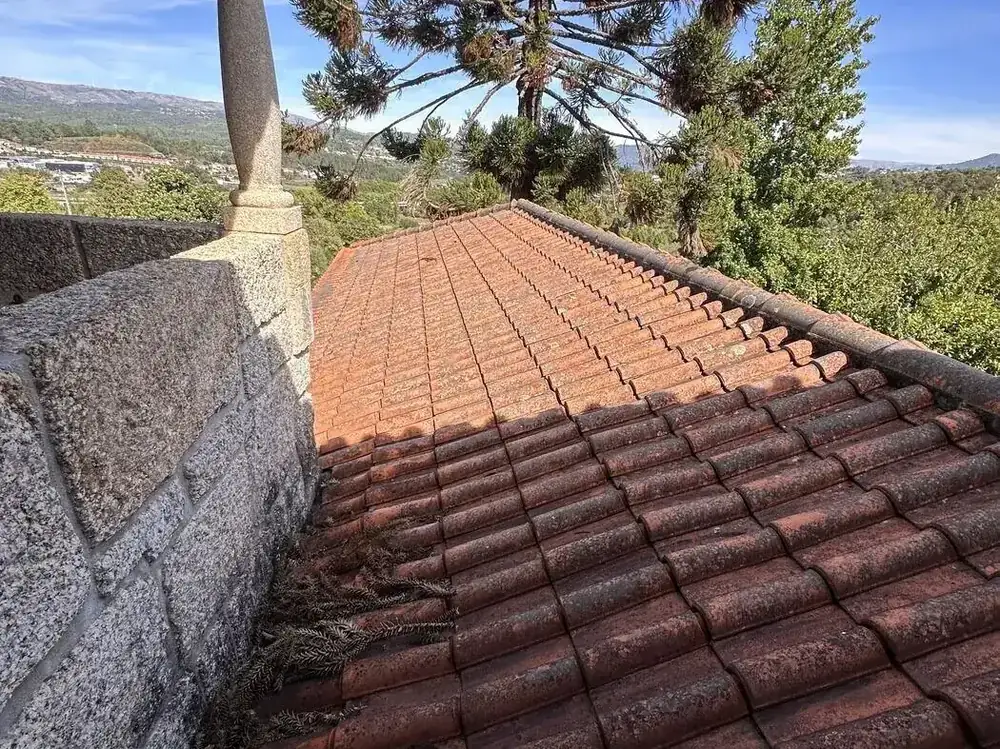
Part of it is that you can’t. There’s no access, no ladder, and the agent isn’t going to produce one. Part of it is that a roof gives you almost nothing to look at from the street — old clay tiles and new clay tiles are the same colour, and a roof with a failed structure underneath looks identical from the pavement to one with thirty years left in it. And part of it, honestly, is that people buy houses emotionally. You fall for a room. Nobody falls for a roof.
So it stays unexamined until it rains properly, which in Porto means a horizontal westerly in November, and then it becomes the only thing anyone can talk about.
Why it costs what it costs
The number that surprises people is that the tiles are the cheap part. On a full re-roof, the covering is a fraction of the bill. Everything else — getting to it, holding it up, keeping water out of it, getting rid of the old one — is where the money goes.
Access is the first big one, and it’s brutal in a Porto street. A terraced building with no side access means everything comes up and down through the front elevation. That’s a scaffold, and if the scaffold stands on the pavement you need the câmara’s permission to occupy public space, with a fee and a notice period, and in the historic core there are further conditions. That’s before a tile has moved. On a narrow street with a bus route on it, the logistics alone can run into weeks and thousands. On a detached house with a driveway you’d barely notice the same job.
Then there’s what’s underneath. Traditional Porto roofs are timber — rafters, purlins, a ridge, sometimes chestnut, often pine — and they were built long before anyone put a membrane under a tile. Water has been getting in at the edges for a hundred years. Usually it’s fine, because the roof breathed and dried. Sometimes it isn’t, and the ends of the rafters where they sit in the wall have gone soft, or a purlin has been quietly carrying a sag for forty years. You do not know which until the tiles come off. That’s the honest answer and any builder who tells you otherwise before opening it up is guessing.
And then it’s not one trade. A proper re-roof is strip-out and disposal, structural repair or replacement, sarking or boarding, a breather membrane, insulation if you’re doing it properly, battens, tiles, ridge and hip bedding, valleys and flashings, gutters and downpipes, and the junctions where the roof meets everything else. Several trades, in sequence, each waiting for the last, all working at height in weather that has an opinion.
Weather sets the window. You don’t open a roof in December. Roof work here runs in the dry months, which means everyone wants the same slots, which means the good roofing teams are booked well ahead. Miss the window and you’re waiting until the following season. That queue is real, and it’s covered properly in how long it really takes to get a builder in Portugal.
The junctions, not the middle
Almost no roof fails in the middle of the tiled slope. They fail at the edges, and the edges in Porto have a particular character.
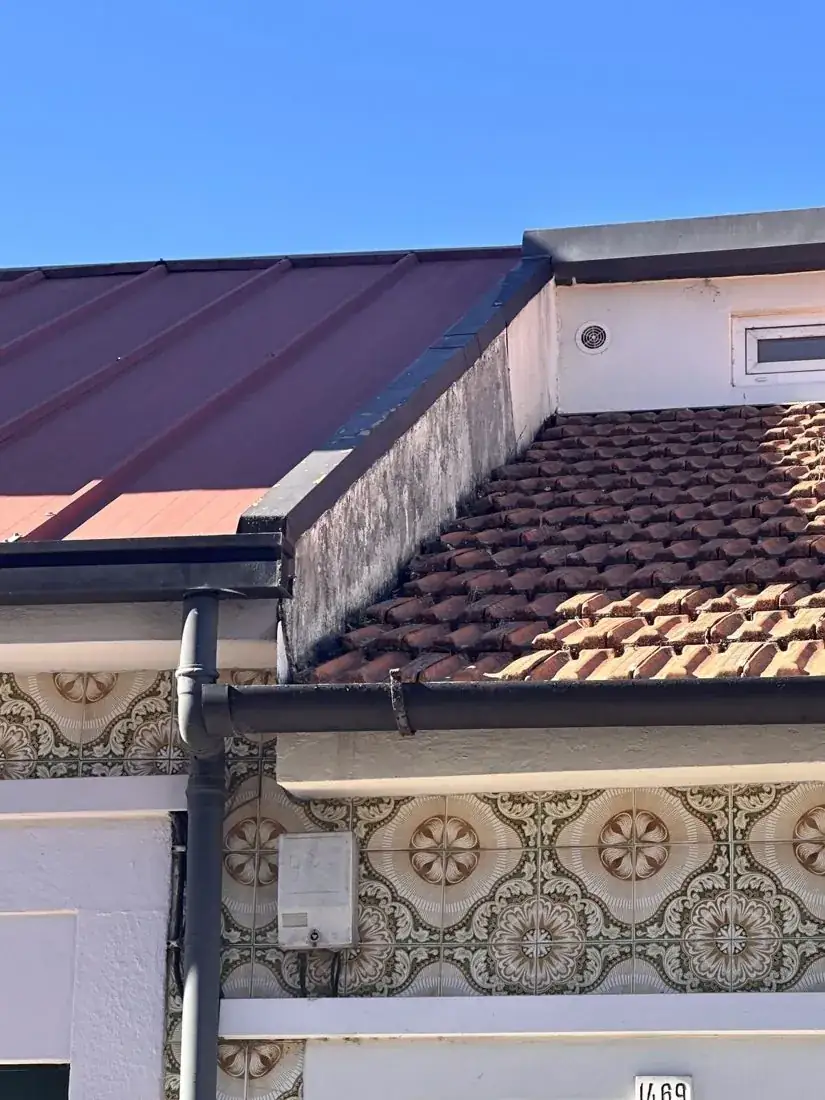
Platibandas and parapets. That decorative parapet wall along the front of half the buildings in this city is a beautiful thing and a permanent liability. Water sits on top of it, gets in through the coping, and runs down inside the wall. The stain shows up in the top-floor bedroom and everyone diagnoses a roof leak. It isn’t. It’s the parapet, and it’s a different repair.
Box gutters — caleiras. The hidden gutter running behind the parapet is the classic Porto failure. It blocks with leaves and pigeon debris, backs up, and instead of overflowing outside into the street it overflows inside, into the roof structure, where nobody sees it for two years. When we find soft timber in a Porto roof it’s usually within a metre of a box gutter.
Party walls. Terraced buildings share walls, and the flashing where your roof meets next door’s is somebody’s responsibility. It’s rarely clear whose. If the neighbour’s roof is failing, yours gets wet, and you now have a conversation to have in Portuguese with a person who has no money to spend on it.
Terraces over rooms. Any flat terrace sitting on top of habitable space is a waterproofing system, not a floor. They have a service life. When they fail, the water arrives in the ceiling below and the repair means lifting everything on top of it.
Looking at a property with this kind of problem? Our pre-purchase inspection finds it and prices it before you sign. From €490 + IVA.
The trap: “it just needs the tiles relaid”
You’ll hear this. Sometimes from a seller, sometimes from a cheerful contractor. A few loose tiles, a couple of days, a few hundred euros.
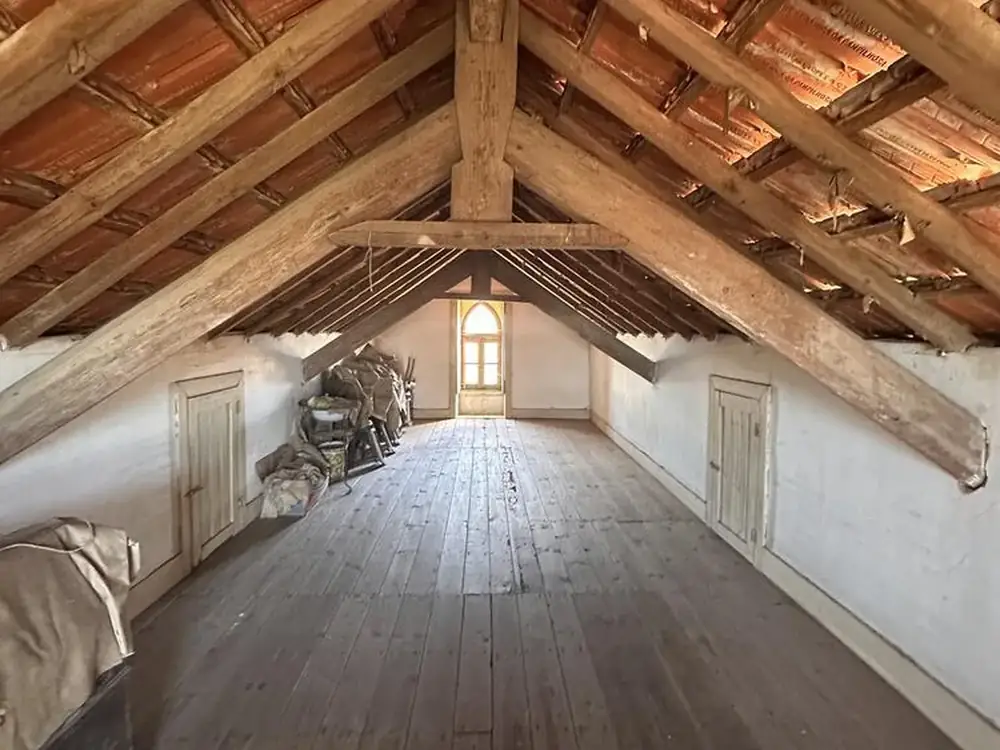
Occasionally that’s true — storm damage on an otherwise sound roof is a real thing and a real small job. Far more often it’s the diagnosis you get from somebody who hasn’t been in the roof space, and it’s the most expensive advice in the trade, because relaying tiles onto a failing structure buys you a season and costs you the whole job again afterwards. You’ve paid for the scaffold twice.
The tell is whether anyone has been inside. A roof assessed from the ground is not an assessment. Get into the loft, look at the underside, look for daylight, look for staining on the timber, press the rafter ends where they meet the wall. Ten minutes up there tells you more than an hour on the pavement.
What it runs to
Indicative ranges, and they move a lot with access and with what’s found once it’s open. A full re-roof in traditional Porto clay tile runs roughly €80 to €150 per square metre, depending on access, structural repair and whether insulation is going in. A partial repair tends to land somewhere around €1,500 to €5,000, though on a scaffolded street front the scaffold alone can eat most of that.
Two things move those numbers hard. Structure, because replacing rafters is a different job to replacing tiles. And scaffold, because a job that needs the street closed is a different job to one you can reach off a driveway.
One thing that can move them in your favour: rehabilitation work on qualifying older properties can attract IVA at 6 per cent rather than 23 per cent, which on a roof is a serious sum. Whether your property and your works qualify is specific to the building and the scope, and it needs confirming with your accountant and the câmara rather than assumed. It catches foreign buyers out in both directions — some pay 23 per cent who didn’t need to, some assume 6 per cent and get a shock. We cover it in more detail in what it costs to renovate in Portugal.
Do the roof first
This is the part owners resist and it’s the part that matters most. When budget is tight, the roof loses, because a roof is invisible and a kitchen isn’t. You cannot photograph a roof for your friends.
But everything downstream of a leaking envelope is money spent twice. New plaster into a damp wall blows. A restored floor under a slow drip cups and lifts. Insulation that gets wet stops being insulation. We’ve been called into houses that were beautifully finished eighteen months earlier and were already staining, and the whole conversation is the same conversation: the roof was left until later, and later arrived early.
Envelope first. Roof, water, structure, electrics. Then the pretty things, and they’ll last.
What to do before you buy
Get someone in the roof space before you sign the CPCV, not after. It’s the one part of a survey that most reliably pays for itself, because a roof at end of life is a five-figure number and a five-figure number is a negotiating position. A documented defect with a real cost attached comes off the price far more often than people expect — both sides of that decision are written up in our case studies, including the apartment we told a buyer to walk away from because nobody had looked at the roof.
And if the property is an apartment, the roof is still your problem — it’s just shared. Get the condominium minutes and the approved works schedule before you commit. A roof replacement voted through last year and not yet levied is a bill with your name on it and no warning attached.
Get the roof looked at before you commit
WhatsApp is the fastest way to reach us — we respond the same day, wherever the property is in Portugal. Our surveys start at €490 + IVA with the report back within 48 hours, and the roof is the first thing we go to.
Message us on WhatsAppBuying a place in Portugal?
We go through it before you sign: roof, damp, structure, electrics and plumbing. Every finding gets a cost range, and so does the renovation you’re planning. From €490 + IVA, written report within 48 hours.
Book a pre-purchase inspectionSee a real reportOr message Brad on WhatsApp. Same-day reply.