Owners renovating in Portugal, especially from abroad, tend to assume somebody is checking the work. There’s an architect, there’s an engineer, the Câmara issued a licence, the builder has an alvará. Surely one of them is looking at the plumbing before the floor goes down. In practice, on most private renovations, nobody is. Here’s who the people on your job are, what each of them is actually paid to do, and where the gap is.
Mid-renovation and nobody’s checking? The Project Room puts a builder on your side of the table: we check the work before it’s covered up, read every extra against the original quote, and show you what you’ve paid against what’s been built. From €690 + IVA a month.
The architect
Designs the job and gets the licence through the Câmara. In Portugal the architect’s fee usually covers the projeto and the licensing. Site visits during construction are either a separate line, assistência técnica à obra, or not in the fee at all. Plenty of owners find out after the fact that their architect was never engaged to visit. When they do visit, it’s to see that what’s being built matches the drawings. Whether the waterproofing went on at the right thickness is not their question.
The engineer
Designs the structure, the drainage, the electrics or the thermal performance, depending on which engineer. Signs the projetos de especialidades for the licence. Same story on site: visits are extra, and when they happen they’re about the engineer’s own specialty. A structural engineer will look at the steel. He won’t look at the shower tray.
The diretor de obra
Named by the builder, on the builder’s side. Legally responsible for running the site in line with the project and the rules. On a small builder’s job this is often the boss himself, or an engineer whose name the builder rents for the paperwork and who appears for the livro de obra signature and little else. Either way, he works for the builder. He is not checking the builder for you.
The diretor de fiscalização
This is the one who is supposed to be yours. Under Lei 31/2009, on a licensed job the owner appoints a diretor de fiscalização de obra, a qualified technician who is independent of the builder and whose job is to check that the work follows the project and the law. He can stop work. He signs the livro de obra. His name is in the licence file.
And here is the gap. Most owners don’t know this role exists. The architect’s office often puts one of its own names down to complete the licence application, the owner never pays a separate fiscalização fee, and nobody turns up. We have been on jobs where the named fiscal had never been to the site. On paper somebody was checking. Nobody had been to the site.
If you have a licensed job running now, ask your architect two questions today: who is the named diretor de fiscalização, and when did they last visit. The answers tell you most of what you need to know.
The Câmara
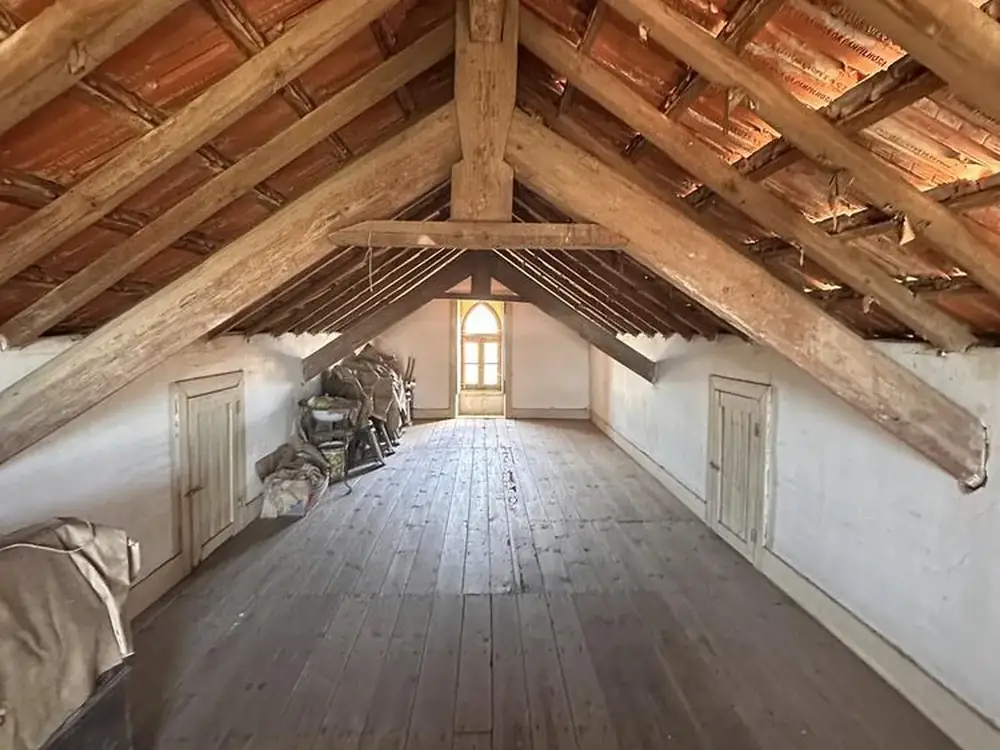
Issues the licence and, at the end, the licença de utilização. Since the Simplex changes of 2024 the Câmara does even less checking than before: for many works it now receives a comunicação prévia and the technicians’ declarations of responsibility, and that’s that. The Câmara is not going to visit your bathroom. See what the 2024 building law changes mean.
The builder’s alvará
An IMPIC licence means the company is registered to carry out works up to a certain value and has shown it has the staff and insurance to do so. It is a licence to trade. It is not a quality mark, and it says nothing about the crew who turn up on your site on a Tuesday. We hold one ourselves. We’d still want someone checking our work if we were the client.
Unlicensed works: nobody at all
A large share of renovations in Portugal are obras isentas, inside the envelope, no licence needed. New kitchen, new bathrooms, new floors, rewire, replumb. No architect need be involved, no fiscal is appointed, and the Câmara never hears about it. Everything above about who checks the work reduces to one answer: the builder checks the builder. If that bothers you, it should. It’s where most of the bad bathrooms we see on inspections came from.
Want someone reading the builder’s extras before you pay them? That’s what the Project Room does. From €690 + IVA a month.
What good checking looks like
It isn’t complicated. Someone who knows how the work should be done goes to site at the points where it’s about to disappear: before the screed goes over the plumbing, before the plasterboard goes over the wiring, before the tiles go over the tanking, before the ceilings go up under a new roof. They photograph it, they say what they saw and didn’t see, and if something’s wrong they say so while it can still be fixed for the price of a morning’s work rather than a week’s demolition.
They also read the paperwork. Each invoice against the work actually done. Each extra against the original quote. That part doesn’t need a site visit. It needs someone who’s priced a few hundred jobs and can tell a fair number from a hopeful one.
Where we fit, and where we don’t
We are not your diretor de fiscalização. That role carries a legal duty under Lei 31/2009 and belongs to a technician appointed for it. What we do is sit on your side of the table: witness visits at the stages that matter, every variation read before you answer it, invoices checked against progress, the programme chased, and a running record of all of it. If the job is licensed and nobody is holding the fiscalização properly, the first thing we’ll do is get that fixed. Then we’ll get on with checking the work.
The legal framework here is Lei 31/2009 and the RJUE as amended in 2024. Roles and duties on your specific job should be confirmed with your architect and, where there is a dispute, a Portuguese lawyer.
What the Project Room looks like
One private page on your phone. No app, no login. This is a demonstration job.
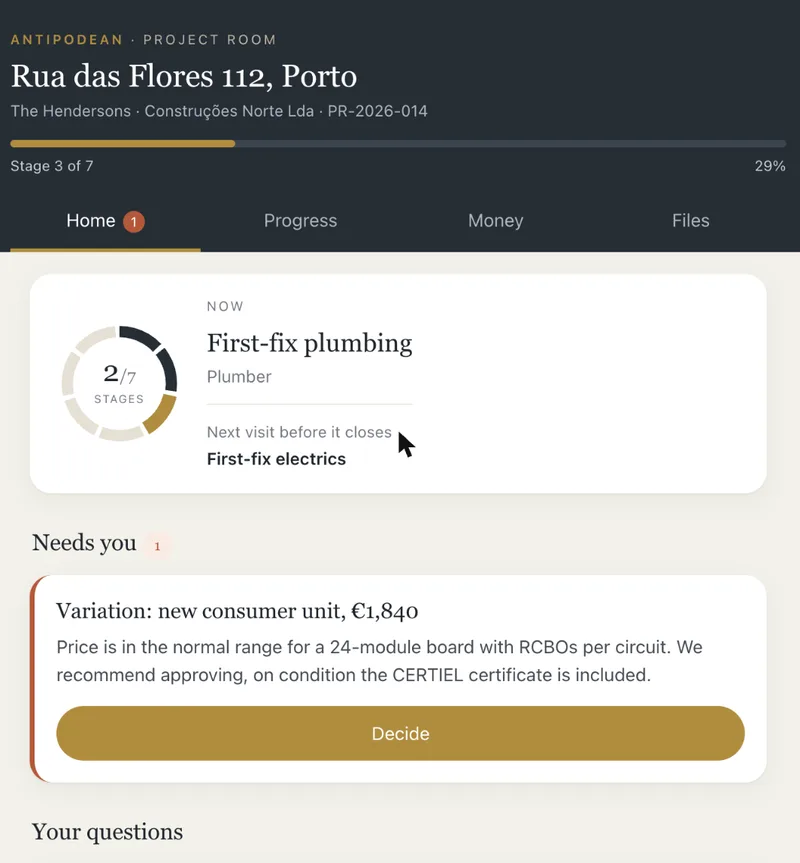
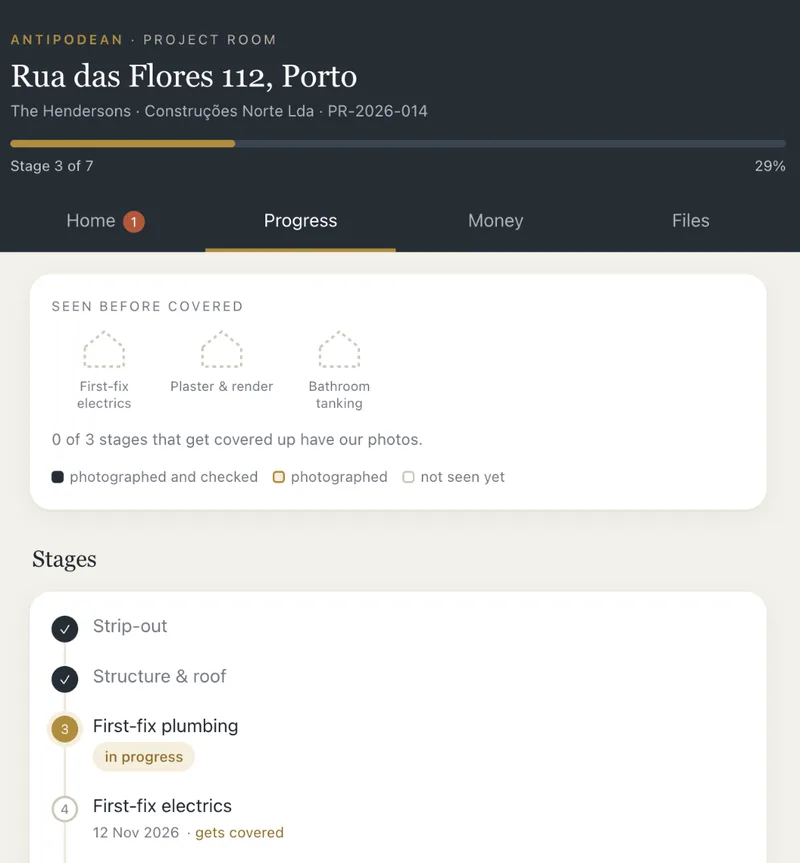
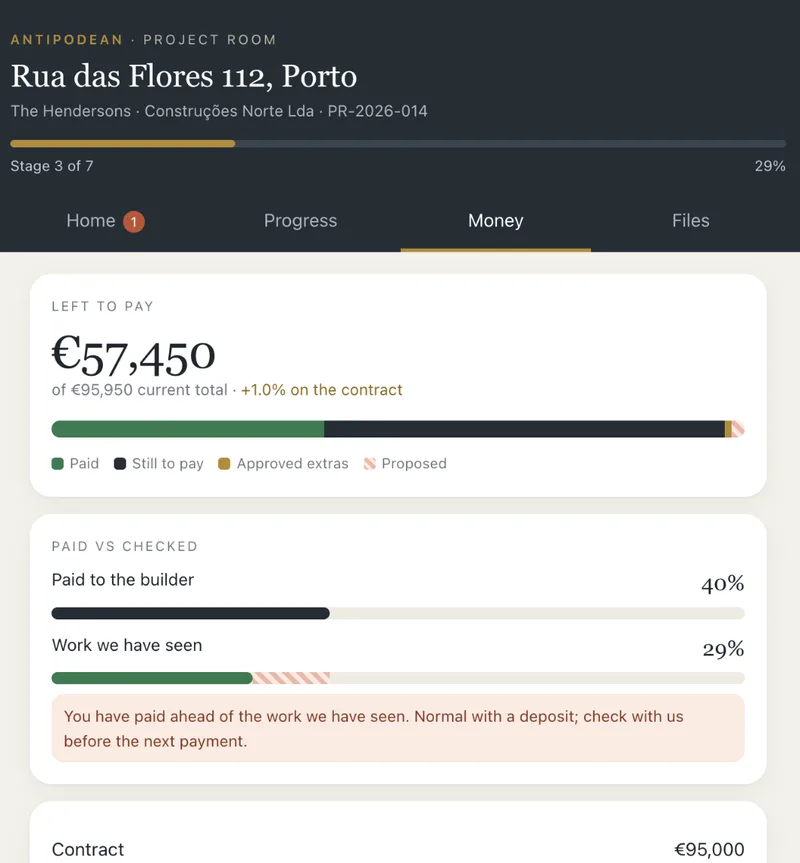
A builder on your side of the table.
You keep your builder. We check the work at the stages that disappear behind plaster and tiles, read every variation against the original quote, and keep what you’ve paid lined up against what we’ve actually seen built. All of it on one private page on your phone. From €690 + IVA a month. If the job has already stopped, Build Rescue picks it up: we assess it, put it in writing and find a builder to finish it.
Haven’t bought yet? Pre-purchase inspection from €490 + IVA.
Or message Brad on WhatsApp. Same-day reply.