A viewing in Portugal is usually twenty minutes with an agent who wants you looking at the view. That’s fine. You aren’t going to inspect a house in twenty minutes and you shouldn’t try. But some things show up straight away if you know what you’re looking at, and they tell you where the money is likely to go. These are the ones I notice first.
Fresh paint in one room, or only on the bottom metre
A whole house repainted for sale is normal. One wall done, or a band of new paint along the bottom of the walls, usually isn’t. In Porto and the north that’s where rising damp and salt show: tide marks, blistering, a white bloom on the plaster. Paint covers it for a few weeks. On a lot of the houses we inspect the mould is already shadowing back through the new coat.
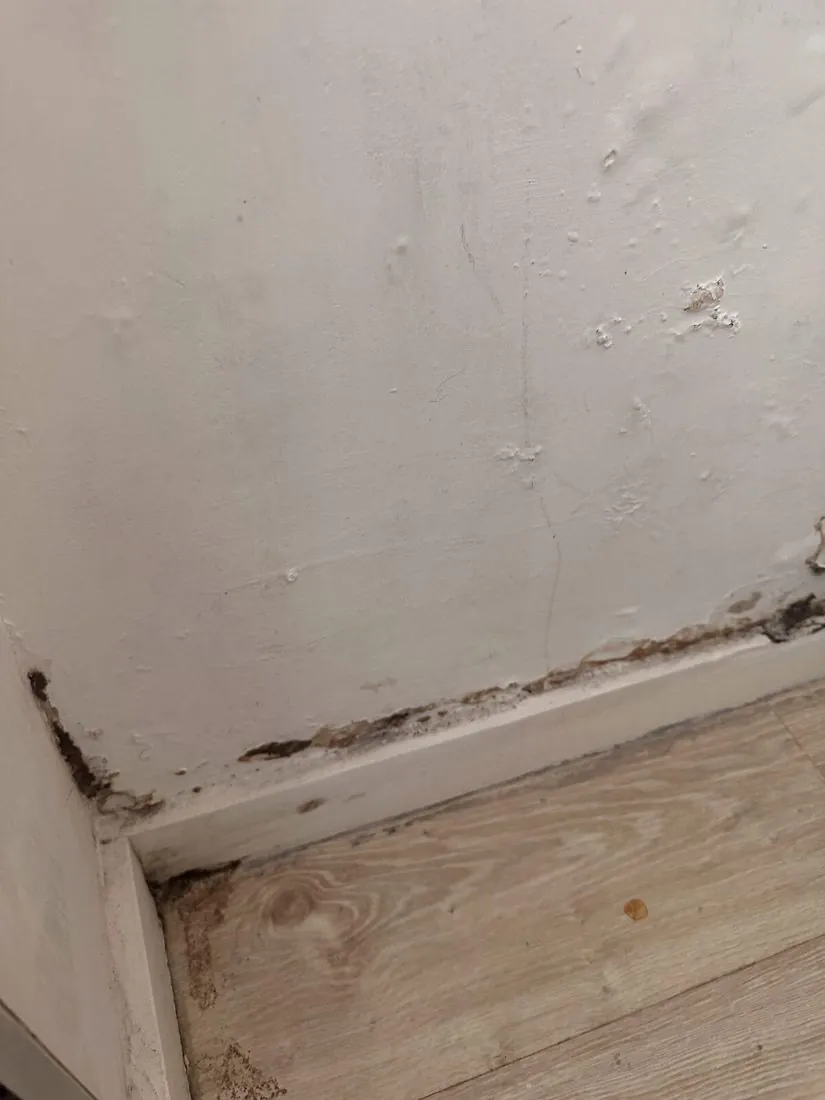
Run your hand along the bottom of an outside wall. Cold and slightly soft is worth noting. Look behind furniture that has been pushed hard against a wall.
A dehumidifier, a heater running, or every window open
A dehumidifier in the corner of a bedroom in October tells you more than the listing does. So does a house with all the windows open on a cold day, or a strong air freshener in a bathroom. These are the usual ways of managing condensation, mould or a drain smell for the length of a viewing. Bathrooms with no working extract fan are one of the most common things we find, and renovated flats sealed up with new windows and no ventilation are a close second. More on that in mould in renovated homes.
A sewer smell is often a missing trap under a basin or shower. Cheap to fix, around €120–250 a point, but it tells you something about who did the plumbing.
Looking at a property with this kind of problem? Our pre-purchase inspection finds it and prices it before you sign. From €490 + IVA.
New tiles on an old terrace
Roof terraces and balconies over living space are where we find the most leaks in apartments. New tiles laid on top of old ones, fresh grout around the outlets, or a brand-new terrace on a building that’s otherwise tired: ask why it was done and whether the waterproofing underneath was replaced or just covered. Then look at the ceiling of the room below. Stripping and waterproofing a terrace of about 25 m² came to €2,800–4,500 on a recent report. A flood test to prove where the water comes from is €200–380.
The roof space nobody can open
“There’s no access”, or a hatch painted shut, or boxes stacked under it. Sometimes that’s just how the house is. Sometimes the roof space is the part nobody wants you to see. Older houses here very often have clay tiles laid straight on battens with no membrane behind them, and the stains on the timber tell you how long it’s been leaking. A full re-roof is often the biggest number on our reports. See what a new roof costs.
Cracks over doors and windows, and doors that stick
Most cracks are cosmetic. The ones worth a second look run diagonally from the corners of openings, step through brickwork, or are wider at one end than the other. A door that won’t close in its frame, or a floor you can feel sloping, belongs in the same conversation. I’ve written a separate guide on which cracks matter.
The electrics board
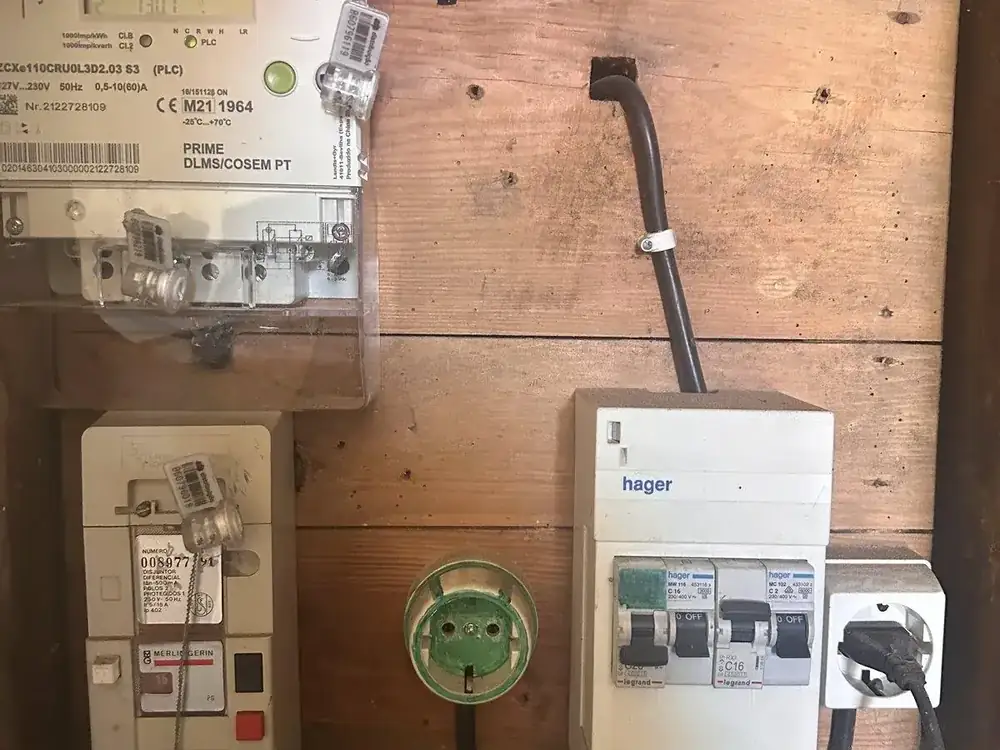
Open the quadro. Old ceramic fuses, no 30 mA residual-current device, cloth or two-core wiring, sockets with no earth pin: you are looking at a new board at the least, and quite possibly a rewire. A board with RCD protection and a certificate runs about €1,800–3,500. A full rewire on a house was €9,000–14,000 on recent jobs. Details in rewiring a house in Portugal.
Windows that run with water
Single glazing, aluminium frames with no thermal break, or condensation pooling on the sills tell you the house will be cold and the walls near the windows will grow mould. We still find the odd pane of plastic in place of glass. Economy double glazing on a two-bedroom flat was about €7,500–8,500 recently; a good thermally broken system for a whole apartment runs €12,000–22,000.
Water with nowhere to go
Look up at the eaves and down at the base of the walls. Missing gutters, downpipes discharging straight against the wall, a garden or a lane higher than the floor inside. On a 17th-century quinta in the Minho with no gutters at all, the water management came to €10,500–17,500 before the walls could even start to dry out.
Recent work nobody has paper for
A closed-in balcony, a converted garage, an extra bathroom in the loft, a pool. Ask what was licensed. Unlicensed works are a legal question for your lawyer, but they’re also a building question: work done without a project is usually work done without an engineer. Read buying after DL 108/2026 for where the law stands now.
What to do with what you’ve seen
Take photos, write it down, and don’t try to negotiate on the spot. None of this tells you what the house is worth. It tells you where to look. Before you sign the CPCV, get the place inspected properly so that every one of these turns into a cost range you can put in front of the seller. What to check before you sign the CPCV covers the rest.
Cost figures are from our own inspection reports and quotes in 2025 and 2026, ex IVA, with names and addresses left out. Every building is different, so treat them as a guide to scale, not a quote.
Buying a place in Portugal?
We go through it before you sign: roof, damp, structure, electrics and plumbing. Every finding gets a cost range, and so does the renovation you’re planning. From €490 + IVA, written report within 48 hours.
Book a pre-purchase inspectionSee a real reportOr message Brad on WhatsApp. Same-day reply.