Buyers see a crack and think the house is falling down. Agents see the same crack and call it settlement. Usually it’s neither. Nearly every house we inspect in Portugal has cracks somewhere, and most of them are cosmetic. The skill is telling the few that matter from the many that don’t, and knowing when it’s a job for a structural engineer rather than a builder.
Reading the width
Surveyors in a lot of countries use the scale from the UK Building Research Establishment (BRE Digest 251), and it’s a sensible starting point here too. Roughly:
- Hairline, under 0.1 mm. Decoration only.
- Very slight, up to 1 mm. Fill and paint.
- Slight, up to 5 mm. Fill, maybe repoint or re-render, and keep an eye on it.
- Moderate, 5 to 15 mm. Repair work, and the cause needs finding.
- Severe, 15 mm and over. Structural work, and an engineer.
Width isn’t the whole story. A 2 mm crack that opened last winter worries me more than a 4 mm one that has been painted over three times and never moved.
The cracks that are usually nothing
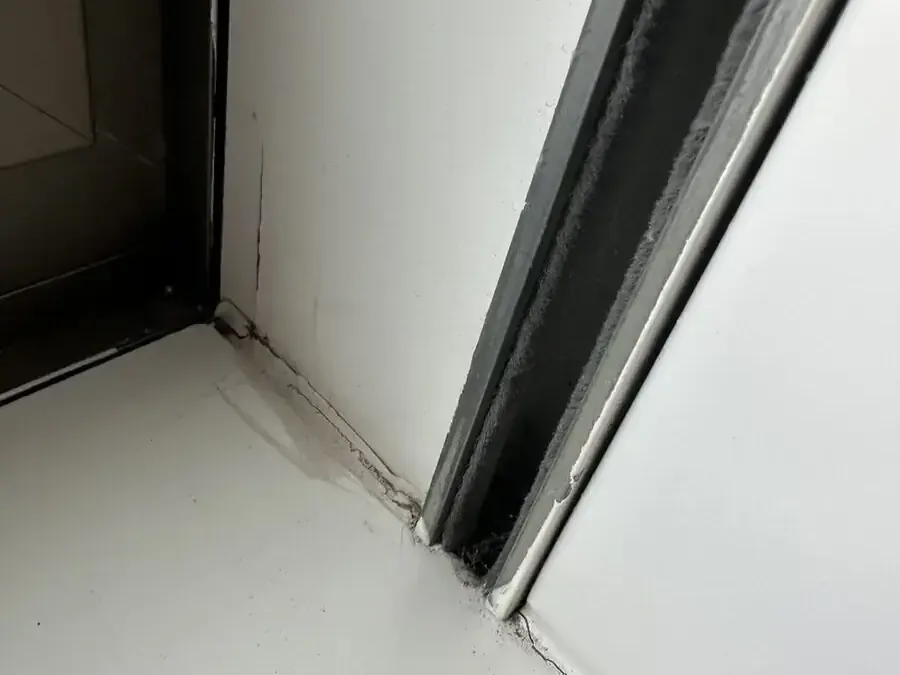
Fine map cracking across old render. Hairline cracks in the ceilings and at the cornices of an old house with timber floors. A vertical hairline where a partition meets a wall. Cracks at the junction between a granite lintel and the plaster around it. Shrinkage cracks in new plaster in the first year. On a recent report we wrote up a fine vertical crack of consistent width, no displacement either side, as low risk: monitor, fill and redecorate. That’s the outcome for most of them.
Looking at a property with this kind of problem? Our pre-purchase inspection finds it and prices it before you sign. From €490 + IVA.
The ones I look at harder
- Diagonal cracks running from the corners of windows and doors.
- Stepped cracks following the mortar joints of brick or block.
- Cracks wider at the top than the bottom, or the other way round. That means one part of the wall is moving relative to another.
- One side of the crack sitting proud of the other.
- Doors and windows out of square, floors that slope, gaps opening between skirting and floor.
- Cracks that have been filled and have opened again.
Concrete buildings: watch the rust
Most flats in Portugal are reinforced concrete frames with brick infill. Cracking in the infill is common and usually harmless. What I look for on a concrete building is rust staining, and concrete breaking away from balconies, parapets and the edges of slabs. That’s the steel corroding inside and swelling. It’s worse near the coast, where the salt gets in. On an apartment it’s normally a building repair paid for through the condominium, so it belongs in the condominium accounts conversation as much as the inspection.
Old stone and timber houses
In an old granite house the walls themselves are rarely the issue. They’re thick and they’ve stood for a long time. The trouble starts where something was changed: an internal wall knocked out to open up a kitchen, a beam end sitting in a damp wall and rotting, a heavy concrete slab poured onto old timber floors, a roof rebuilt in concrete on walls never meant to carry it. Cracks in those houses point you to the alteration.
When the neighbours are the cause
One case from this year: a terraced house in Porto where the ruin next door was demolished. Within weeks a crack had opened along the parapet where it used to meet the neighbouring building, with about 10 mm of displacement and water coming into the attic store. The parapet had been waterproofed shortly before, and the crack ran through the new membrane, which dated it. If you are buying next to a ruin or an empty plot, ask what is planned there.
What “monitor” actually means
When a report says monitor, it should mean something specific. Fix glass or plastic tell-tales across the crack, or mark the ends and measure the width, and write down the date. Check every month or two through a full winter and summer. If nothing moves, it’s historic and it’s a repair. If it keeps opening, you have active movement and you need an engineer. When we repair a crack on a job we date the repair for the same reason: if it reopens and widens, rather than coming back as a hairline, that tells you something.
When you need a structural engineer
A builder can tell you a crack is cosmetic, and a builder can tell you something is moving. Deciding why it’s moving and what has to be done about it is an engineer’s job: active movement, cracks in the moderate band or wider, alterations to load-bearing walls, and in the south, questions about how the building would behave in an earthquake (see earthquake risk in Lisbon and the Algarve). Structural changes inside a building also need a term of responsibility from a qualified technician under the 2024 rules, even where no licence is needed.
We bring in a registered structural engineer when a finding needs one, quoted per job. Most of the time it doesn’t.
Before you buy
Photograph the cracks at the viewing, note where they are, and get them looked at before the CPCV. The inspection tells you which are paint and which need money, and puts a range on the ones that do. Where it needs an engineer, you’ll know before you’ve paid a deposit. See also red flags at a viewing.
Cost figures are from our own inspection reports and quotes in 2025 and 2026, ex IVA, with names and addresses left out. Every building is different, so treat them as a guide to scale, not a quote.
Buying a place in Portugal?
We go through it before you sign: roof, damp, structure, electrics and plumbing. Every finding gets a cost range, and so does the renovation you’re planning. From €490 + IVA, written report within 48 hours.
Book a pre-purchase inspectionSee a real reportOr message Brad on WhatsApp. Same-day reply.