Buyers send us listings every week asking whether a place is worth a look. By the time we’ve read the text and flicked through the photos we usually have a fair idea, before anyone has been near the house. Not of the price. Of what the first inspection is going to find. Here’s what we read, in the order we read it, and the four questions worth asking the agent before you book a viewing, let alone an inspection.
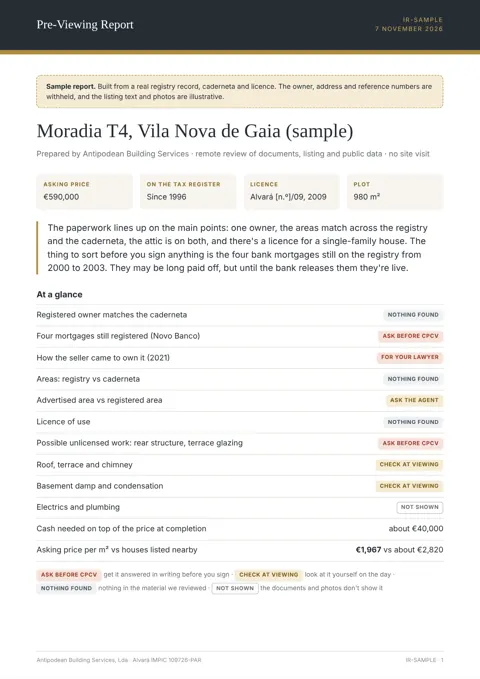
Send us the listing before you view it or make an offer. Casa v Casa checks the paperwork, the building and the full cost of buying, with the likely works priced in. €99 for one house, €189 for up to three, back within 4 business hours.
Order a Casa v Casa reportSee a sampleBuying a place with this in mind? Our pre-purchase inspection covers it, with a cost range on every finding, from €490 + IVA. Weighing two or three properties? Put them side by side first with Casa v Casa (€189 for up to three), or have Property Advisory inspect and compare them.
The words that mean more than they say
The full list of terms is in our listing decoder. These are the ones that matter most.
Remodelado. Renovated. The most expensive word in Portuguese property. It covers everything from a full strip-out with new services to a coat of paint and a kitchen from a catalogue. On our inspections, “remodelado” flats are where we find the most problems, because the finishes are new and the fabric behind them is not. New tiles over a terrace that still leaks. Plasterboard over damp granite. A new consumer unit on 1970s wiring. Read it as “somebody has spent money on what you can see”. What we find behind it is in badly renovated houses.
Para recuperar / para restaurar. To be done up. Usually straight talk, and a cheaper way in if you know what you’re doing. The number to worry about isn’t the asking price. It’s the asking price plus the renovation, and the second half is the one buyers underestimate. Start with the costs that don’t make it into the budget.
Bom estado de conservação. Good state of repair. It means the agent didn’t see anything falling off. It doesn’t mean the roof has a membrane.
Ano de construção. Build year. This one is worth a lot. Pre-1951 in Porto or Lisbon usually means no licença de utilização is required, which is fine, but it also means granite walls, timber floors and whatever has been done to them since. 1960s to 1980s means concrete frame, brick infill, no insulation and plumbing and wiring at end of life unless replaced. Anything after about 2010 should have a thermal certificate worth reading. If the year is missing from the listing, ask. If the agent doesn’t know, the caderneta predial will.
Último andar / cobertura. Top floor. Beautiful light, and you own a share of the roof above you. If that roof is tired, the bill comes through the condominium and you pay your permilagem of it. See buying a top-floor flat.
Rés-do-chão. Ground floor. In an old Porto building this is the floor that sits on the ground, and the ground in Porto is wet. Rising damp is the default, not the exception.
The photos, and the photos that aren’t there
Agents photograph what sells. We look at what’s missing. A listing with twenty shots of the living room and none of the bathroom ceiling, the kitchen under the sink, the roof or the back of the building is telling you where to look first.
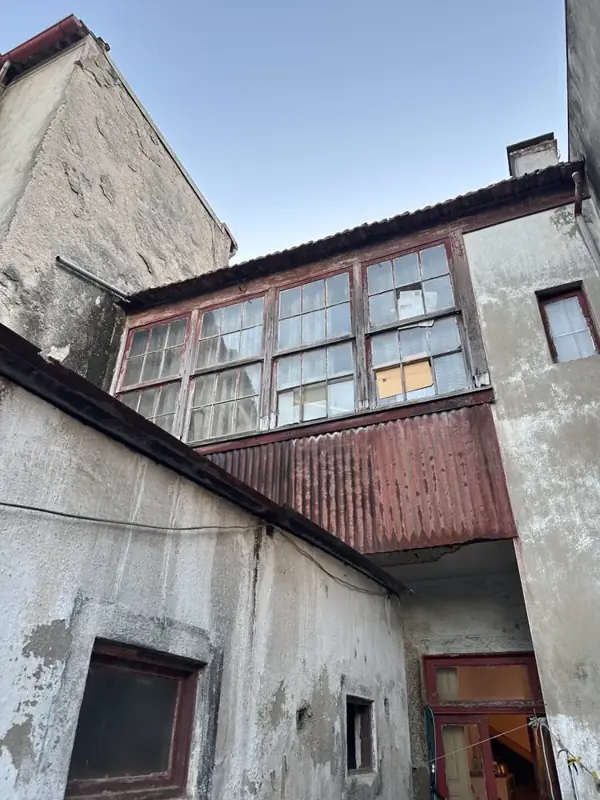
- No photo of the rear elevation. On Porto houses the front is granite and azulejo and the back is where the extensions, the enclosed balconies and the leaks are.
- No photo of the roof or attic. On a house, the roof is the single biggest number on most of our reports. On a top-floor flat it’s your share of it.
- Fresh paint in one room only. Look at the ceiling in that room in the photo. Mould shadows through emulsion inside a winter.
- Furniture against every external wall. Sometimes it’s staging. Sometimes it’s where the tide marks are.
- Wide-angle lenses. Everything looks bigger. Check the m² on the caderneta, not the feeling in the photo.
The numbers worth checking before you go
Área bruta vs área útil. Gross area counts the walls, sometimes the balconies and a share of the stairwell. Useful area is what you can walk on. Listings tend to quote the bigger one. The gap on an old building can be 25%.
Energy certificate. A class F or G on a “remodelado” flat is a contradiction worth asking about. Either the renovation didn’t touch insulation, windows or heating, or the certificate predates it. Either way you want to know which.
Condominium fee. Very low on an old building usually means no reserve fund and no works being done. See the flat was fine, the building had €456 in the bank.
Four questions for the agent before you view
- What year was it built, and when was it last renovated, and what did the renovation include? Push past “everything”.
- Is there a licença de utilização, and does it match what’s there now? An attic conversion or an enclosed balcony that isn’t on the licence is your problem after the escritura, not the seller’s.
- Can I see the last two years of condominium minutes and accounts? On a flat, this tells you more about the next five years than the viewing will.
- When was the roof last worked on, and is there any paperwork for it? A shrug is an answer too.
Agents who answer these clearly are agents worth working with. Agents who get vague are telling you to get the place inspected before you sign anything, which, to be fair, you should do anyway. What we check and what you get is on the pre-purchase inspection page. The CPCV side is in what to check before you sign the CPCV.
When a listing is good enough to skip the viewing and go straight to the inspection
It happens, mostly for buyers abroad. If the location is right, the price is in range, the build year and the energy class make sense together and the agent has answered the four questions without wriggling, an inspection on the first visit saves a flight. We arrange the access, go through it, send the report and talk it through on a call. Several of our clients this year bought a house they first walked into on completion day. They knew it better than most buyers who’d viewed three times.
Nothing here replaces reading the caderneta, the licence and the registo predial, which your lawyer does. This is what the building tells you before the paperwork does.
Casa v Casa puts up to three side by side: the paperwork, the building and what each one will really cost you once taxes and likely works are added. €99 for one, €189 for up to three.
See how Casa v Casa works →Buying a place in Portugal?
We go through it before you sign: roof, structure, damp, drainage, electrics and plumbing. Every finding gets a cost range, and so does the renovation you’re planning. From €490 + IVA, written report within 24–48 hours, Portuguese version included.
Bought already and about to renovate? The Project Room puts a builder on your side of the table from €690 + IVA a month. Holding a builder’s quote? Quote Check, €220 + IVA.
Or message Brad on WhatsApp. Same-day reply.