If you are building or renovating in Portugal while you live somewhere else, you need someone on site who answers to you and has no connection to the builder. That person checks the work before it gets covered up, checks the invoices before you pay them, and tells you in plain English where the job really stands. Without that, you are relying on photos the builder chose to send you.
Most of the calls we get from overseas owners arrive after that has already gone wrong. So here is how it goes wrong, and what it looks like when it's set up properly from the start.
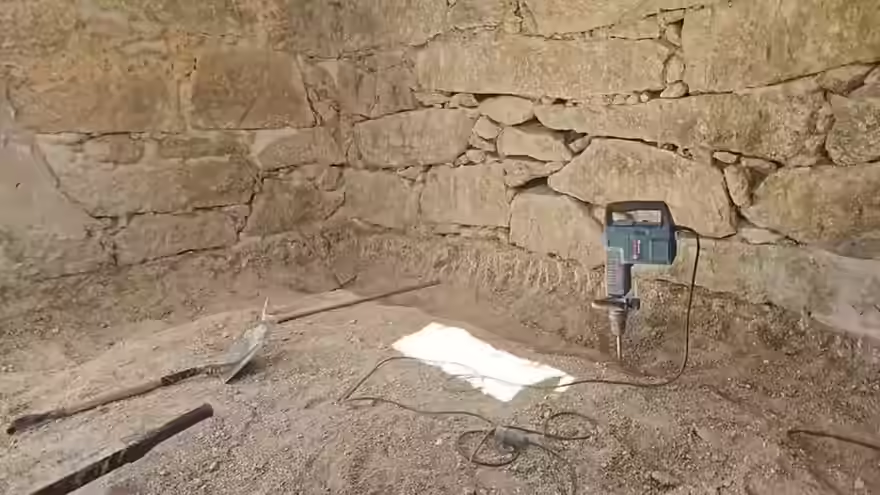
What happens when the owner isn't there
It rarely starts with anything dramatic. The builder you hired is usually decent enough. But he is running three or four jobs, and yours is the one where nobody turns up unannounced. So yours is the one that gets the crew on a Friday afternoon, the one where the membrane goes on a bit thin, the one where a stage gets invoiced a fortnight before it's finished.
You see it through WhatsApp. A photo of a wall. A voice note saying everything is going well and the next payment is due. You can't tell from a phone in London whether that screed has the fall it needs toward the drain, or whether the insulation behind the plasterboard was ever put in. Nobody can.
Then the programme starts to slip. A week here, a fortnight there. There's always a reason, and usually it's even a real one. After a year the owner flies over for the first proper look and finds a building that is further behind, and costing more, than anything they'd been told.
Why the builder can't manage himself
People ask why they should pay someone to watch a builder they already trust. Fair question. The problem is the builder has a commercial interest in how the job gets recorded. He wants his payments on time, and he wants variations priced in his favour. He also doesn't want to pull out work that's already gone in. None of that makes him dishonest. It just makes him the wrong person to sign off his own work.
The architect is often assumed to cover it. Sometimes they do. More often the architect's appointment covers the design and the licensing, with a handful of site visits, and it stops well short of checking every stage and every invoice. On licensed works there should also be a diretor de fiscalização de obra, a technician appointed on the owner's side to supervise the works. In our experience that role is too often a name on a form and a visit a month. Ask who holds it on your job and how often they are actually there.
What a client-side project manager does, week to week
Before a single tool comes out, the scope gets written down properly. Every room, every element, finishes specified, so that the builders tendering are all pricing the same thing. Then the contract goes in your name, with a payment schedule tied to stages that get inspected. Money leaves your account after a stage is checked, never before.
During the build, the work is about being there at the right moments. Before a slab is poured. Before walls are closed. At first fix for electrics and plumbing, and again before plastering. These are the points where a mistake costs almost nothing to put right, and a month later costs a fortune. We use thermal imaging and moisture meters on the same work we'd use them on in a survey, because damp and missing insulation don't show until it's too late.
Around that, it's paperwork and people. Checking the builder's valuations against what is standing. Pricing variations before they're agreed, not after. Keeping the trades in the right order so the tiler isn't waiting on the plumber. Chasing the Câmara when something is stuck. And a written report with photos on a regular cycle, so you know where the job is without getting on a plane.
The owner makes the decisions. We make sure they're made on real information and in time. A late decision on window colour or kitchen layout can hold a job up for a month, and it happens more than anyone would guess.
Setting it up before you commit
A few things are much easier to get right at the start than to fix halfway through.
Hold the building contract yourself. If a manager or agent holds it, you lose your direct hold over the builder if things fall apart. Your manager should be advising and checking on your behalf, while you remain the employer.
Sort the Portuguese admin early. A NIF, a local bank account, and very often a power of attorney so someone can sign for you at the Câmara or the utilities. Those are jobs for your lawyer, and they take longer than you'd think.
Agree how decisions get made. Who signs off a variation, how quickly, and in which currency the numbers get reported. Couples building together should agree between themselves who has the final word before the builder asks.
Budget a contingency and leave it alone. On renovation work, 15 to 20 percent is where we start. Older buildings in the north almost always have something behind the plaster that nobody could have priced.
What it costs
Independent management is normally priced as a fixed fee for the set-up work, meaning the scope, the tender and choosing the builder, and then a percentage of the construction value for running the job. The percentage depends on how often someone needs to be on site. A job an hour from Porto with fortnightly visits is a different thing from a remote quinta that needs someone there every week.
Set it against what it saves. One stage paid for before it's built, one badly priced variation, or one wall opened up again because the waterproofing was never done will usually cost more than the fee. Most owners who come to us after a build went wrong say the same thing: they'd have paid it gladly at the start.
Building or renovating from abroad? We scope the work, tender it to vetted builders and run the job on your side, with the contract in your name. See Project Management, or message us on WhatsApp. We work the length of Portugal.
Related reading: building a new house in Portugal, stage by stage, how to pay a builder in Portugal and why three builder quotes are never comparable.